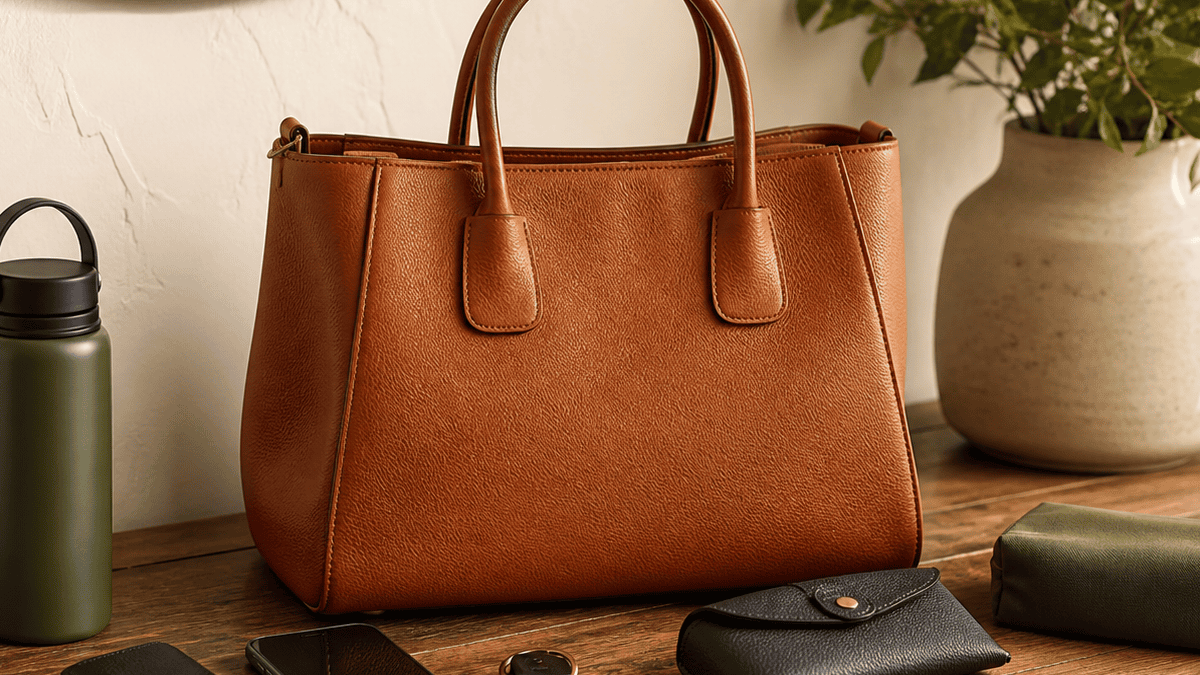
The best everyday handbag is not necessarily the most fashionable or expensive option. It is the bag that carries what you genuinely need, feels comfortable at the end of the day, works with your normal outfits, and remains easy to maintain.
List what you actually carry
Empty your current bag and divide the contents into daily essentials, occasional items, and things that simply accumulated. Daily essentials might include a phone, wallet, keys, sunglasses, small pouch, and water bottle. Commuters may also need a laptop, charger, notebook, or lunch container. Photograph the final group so you can compare it with product dimensions.
Measure capacity, not just width
Online measurements can be misleading when a bag has a narrow opening, tapered sides, or a structured base. Compare width, height, and depth with a bag you know. Check whether the listed dimensions are external or internal and whether the opening is wide enough for your largest item.
Choose the right carrying style
A shoulder bag is quick to access but can become uncomfortable when heavily loaded. A crossbody distributes weight more securely and leaves both hands free. A tote offers capacity and a clear opening but may need an internal pouch system. A convertible design can be helpful, although extra hardware adds weight.
Check the empty weight
Weight is one of the most overlooked specifications. A beautiful bag that feels heavy before it is filled is unlikely to become an effortless daily choice. If the retailer lists weight, compare it with your current bag. Wide straps, adjustable lengths, and smooth strap edges also improve comfort.
Match the closure to your routine
Zippers offer the most security for public transport and travel. Magnetic closures are convenient but may leave the contents exposed. Open totes work best when used with zip pouches or an organizer. Test whether you can open the bag with one hand and whether the closure catches on delicate clothing.
Look for useful organization
More pockets are not always better. One secure pocket for valuables, one easy-access pocket for a phone, and an uncluttered main compartment are enough for many people. Light-colored linings make small items easier to find. A removable pouch is easier to clean than a fixed complex interior.
Evaluate materials honestly
Smooth leather looks refined but can show scratches. Pebbled leather is often more forgiving. Canvas is light and casual but may absorb spills. Nylon is practical in wet weather and easy to clean. Vegan materials vary widely, so examine edge finishing, flexibility, and care instructions rather than relying on the label alone.
Use a simple decision score
Score each candidate from one to five for capacity, comfort, closure, organization, maintenance, outfit compatibility, and value. Eliminate any bag that fails a non-negotiable requirement, even if the total score is high. This prevents an attractive design from outweighing daily usability.
Frequently asked questions
What color is most versatile?
The most versatile color is one that works with your own coats and shoes. Black, dark brown, taupe, navy, and olive are common choices, but your wardrobe should decide.
How large should an everyday bag be?
It should hold daily essentials with a little free space, without encouraging unnecessary weight.
Is a zip closure necessary?
Not always, but it is valuable for commuting, cycling, crowded environments, and frequent travel.
How can I make a tote more organized?
Use two or three purpose-specific pouches or a lightweight removable organizer.
When is a handbag worth repairing?
Repair is often worthwhile when the structure and material remain sound and the problem is limited to hardware, stitching, lining, or a strap.
Related ChicSeed guides
Continue with these practical guides from the same topic area:
